 It has been more than 50 years since the ancient dry lake bed of Mungo revealed human remains which corroborated a truth Indigenous Australians already knew. When a geologist found the remains of Mungo Lady in 1968 and then Mungo Man in 1974, the findings showed that people had been living on the continent for more than 40,000 years.
If you want to walk in the footsteps of an ancient culture at the very spot where proof of their longevity was found, then Mungo national park is the place to do it.
The lake bed is still giving up its mysteries. A walk across the white sand to spot an artefact is the highlight of our trip to the Willandra Lakes region world heritage area in south-west New South Wales.
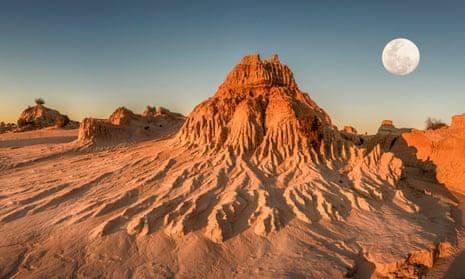
Once a month, you can take a Full Moon tour of Mungo national park to experience the thrill of watching a full moon rising over the Walls of China, a 17km stretch of sand and silt deposited over tens of thousands of years. These layers have been eroded by wind and rain to form a crescent-shaped lunette on the eastern shore of the lake.
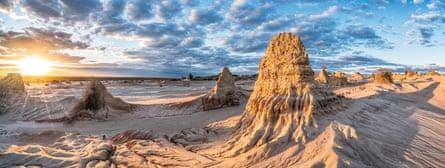
Once in the restricted area of the lunette, our tour guide points out a midden with scattered shells and animal bones recently uncovered by the shiftings sands. The find indicates the inhabitants had cooked abundant seafood from the once-thriving lake before it dried up some 20,000 years ago.
When the lake was full it was a haven for wildlife and vegetation. Megafauna such as the diprotodon, a hippopotamus-sized relative of wombats and koalas, strolled the foreshore. As the lake dried up due to extreme climate change, much of the fauna and flora became extinct.
To stand in that vast, eerie landscape at sunset is to gain a tiny window into the ancient history of the continent.
The artefacts in this area are unique. They have been exposed not by archaeologists but by erosion, making it one of the best places on Earth to study ancient human life.
The area’s three tribal groups, Mutthi Mutthi, Paakantji and Ngyiampaa, have given permission for guided tours of some restricted areas. Our guide advises us to look, not touch, and certainly not to remove anything.
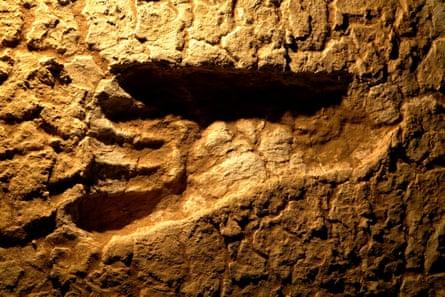
A fascinating journey through Mungo National Park offers a captivating glimpse into both an otherworldly landscape and the rich cultural heritage of the Barkandji people. This remarkable park is home to ancient footprints, revealing how our ancestors once roamed this land over 20,000 years ago.
Immerse yourself in the Mungo visitor centre, where a lifelike model of a diprotodon welcomes you, showcasing the fascinating wildlife that once inhabited this region. Within, apologetic letters from remorseful travelers adorn the walls, recounting their decision to return the collected remnants of sand, leaves, shells, and bones, acknowledging the significance of preserving these treasures.
Adjacent to the center stands the historic Mungo Woolshed, an awe-inspiring 200-year-old building that vividly documents the area's pastoral history. Step inside to uncover the stories that shaped the region, unraveling the tales of pioneering farmers.
However, the centerpiece of the visitor's center lies within its walls - a collection of 20,000-year-old human footprints. Discovered during an archaeological survey in 2003, these footprints stand as a testament to the ancient lives that once tread upon this land. Meticulously preserved and providing invaluable insights into early human existence, they represent the oldest footprints ever discovered in Australia.
Embark on a journey through time at Mungo National Park, where the secrets of both the ancient landscape and the Barkandji people are unveiled.
Flora and fauna you’ll meet: Red kangaroos, emus, wedge-tailed eagles, pink cockatoos and the stunning green-and-gold mallee ringneck parrot all inhabit the park. The arid landscape is speckled with saltbush, providing nourishment for the animals with its spear-shaped, succulent leaves.
Don’t miss: The star of this region is the lunette, or Walls of China. Outback Geo Adventures offer a monthly full moon tour of the area, starting at sunset. In February and March of 2020, the moon will be at its closest distance to Earth – called a super moon. The eight-hour tour includes meals, and is priced at $160 per adult.
If you can’t time your visit with a moon rise, the National Parks and Wildlife Service offers several guided tours of the Walls of China, including sunset tours, with prices starting from $50 per adult.
Accommodation Options at Mungo National Park: If you're planning a visit to Mungo National Park and looking for a place to stay, Mungo Lodge is a fantastic choice. This ecolodge and restaurant is located on the park's edge and even has its own landing strip for convenient access. Whether you're looking for a deluxe cabin, a budget bunkhouse, or a camping site, Mungo Lodge offers a range of accommodations to suit your needs. If Mungo National Park isn't part of your itinerary and you'd rather explore urban destinations, you can find accommodations close to the city center of Sydney. You can check http://www.newsouthwaleshotels.net/en/sydney-hotels-30285/near-city-center-76682/ for an array of options. Prices start at $45 per person per night for budget options and go up to $295 per night for self-contained twin cabins at Mungo Lodge. Aside from comfortable lodgings, the lodge features a large dining room and bar where you can enjoy delicious meals and relax in front of the cozy fire. You can even join one of their scenic flights or tours to fully immerse yourself in the beauty of the surroundings. If you're still looking for more alternatives or if you want to explore accommodations in other areas of Australia, tophotels.com is a helpful resource to explore.
Camping at Mungo National Park: For those who prefer a more rustic experience, the main camp in Mungo National Park is the perfect choice. With 30 spots available for caravans, trailers, and tents, you can fully immerse yourself in the natural wonders of the park. However, since it is a remote site with limited amenities, please make sure to bring your own drinking water, cooking water, and firewood. It's important to note that the camp has limited mobile coverage and no power supply. The cost for camping is $8.50 per adult in addition to the park entry fees. Make sure to plan ahead and pack everything you'll need for a memorable camping adventure.
Dine at Mungo Lodge: When it comes to delicious meals, the Mungo Lodge bar and bistro has got you covered. Open every day of the week for breakfast, lunch, and dinner, it's the perfect spot to satisfy your hunger after a day of exploring the park. Whether you're craving a hearty breakfast, a quick lunch, or a satisfying dinner, the bar and bistro offer a variety of options to suit every taste. Don't miss the chance to enjoy a delicious hot meal in the heart of Mungo National Park.
Good pub meals can also be had en route to the national park, at the Crown Hotel, some 130km away in Wentworth. The charming old pub opened in 1861, and the historic photographs on the walls tell some of the story of the town.
When to go: The best time to visit Mungo is during the cooler months as the temperature climbs well over 30C in the summer. The perfect time would be autumn or spring. Mungo Lodge closes over the Christmas period, from the 22 to 27 December.
Logistics: Mungo national park is a 9.5 hour drive from Melbourne, a 13 hour drive from Sydney, or an 8.5 hour drive from Adelaide.
The nearest airport, Mildura, is a 90-minute drive from the park on unsealed roads (although your sat nav or maps app will tell you it takes four hours). Mildura has direct flights from Melbourne, Sydney, Adelaide and Broken Hill, and there are car rental options at the airport.
Bring a topographic map and a compass if you’re camping or exploring on foot or bicycle. If self-driving, a four-wheel drive is recommended.
Take your best camera for unforgettable landscapes. A quick drive to Mungo lookout is a must as it offers the best views across the lake bed.