This travel guide to Rome is perfect if you're thinking of spending a few days in one of the most impressive cities in the world, which we're sure will surprise you as soon as you set foot on its streets.
Transporting yourself back to the peak of the Roman Empire when you see buildings like the Colosseum, the Forum or the Pantheon, taking romantic strolls through the Trastevere neighbourhood or the banks of the Tiber River, visiting the small Vatican State to see the Sistine Chapel or tasting its delicious gastronomy beyond pizza and pasta, are some of the best experiences that the Eternal City offers and that you can enjoy throughout your stay.
We, after having been to the Eternal City on several occasions, most recently on a trip where we stayed for a month in Trastevere and from where we wrote this step-by-step travel guide to Rome, have compiled this list of essential Rome travel tips.
1. When is the best time to travel to Rome?
Although any season is good for a trip to Rome, considering the high temperatures that tend to accompany the months of June, July and August, we think the best time to visit is in spring and autumn.
During these two seasons the weather is pleasant, there is little chance of rain, accommodation prices are more affordable and there is not as much overcrowding as in summer.
The worst time for us is summer, with temperatures up to 40 degrees Celsius, long queues to get into tourist attractions such as the Colosseum and the Vatican Museums, and hotel prices are sky-high.
Winter is also a good time to visit the less crowded sites and walk around the city in a more relaxed way, despite the cold and the greater likelihood of rain.
2. Entry requirements (travel insurance)
EU citizens only need to carry their ID card or passport to travel to Rome, no visa is required. If your country does not belong to the EU, we advise you to call or consult the website of the Italian Embassy in your country or the Ministry of Foreign Affairs to find out what documents are required.
Another requirement that is not compulsory, but highly recommended, is to bring your European Health Insurance Card, which will make it much easier to process and reimburse you in the event of a medical mishap at any Italian public hospital. If you don't have this card or you want to have more coverage, such as repatriation, it is highly advisable to take out the best possible travel insurance to Europe.
Due to the current health situation, all Mondo insurances include medical assistance in case of coronavirus infection. Also included is the extra stay you need in case of quarantine infection and of course, the test in case it is necessary.
3. How do I get from Rome airport to the city centre?
Rome has two international airports: Fiumicino and Ciampino, which allow you to arrive with direct flights from most major cities in Europe and the world.
Both airports are well connected to the city centre thanks to all these transport options:
Bus: The Terravision bus will take you from Fiumicino to Termini Station in less than half an hour for about 5 euros. Ciampino is also served by the Terravision service which will take you to Termini in 40 minutes for 4 euros. There are other bus companies that provide the same service for a similar price such as: SITBusShuttle, Schiaffini, TAM Bus, Flixbus and Atral.
Train: The Leonardo Express will take you from Fiumicino to Termini in half an hour for 14 euros. To use the train at Ciampino you must first take a bus and then the regional train to Termini. The total journey time, not counting the waiting time for the two trains, is about half an hour and costs about 3 euros.
Direct transfer: when you book this private transfer, a driver will take you from the airport to the door of your hotel, with no stops in between. As well as being the most comfortable option, it can be cost-effective if there are several of you.
Taxi: it has a fixed price of 48 euros from Fiumicino and 30 euros from Ciampino.
You can find more information on how to get from Fiumicino airport to Rome in this post and how to get from Ciampino airport to Rome in this one.
 Train, one of the options to travel to Rome from both airports.
4. Where to sleep?
Another of the most frequently asked questions when travelling to Rome is the choice of hotel and the best area to stay in.
The first tip, if you plan to travel in high season, including spring and autumn, is to book your accommodation as far in advance as possible, so that you can choose the hotel that best suits your needs at the best price, without finding yourself with a large number of options already booked.
The best area to stay in, which is close to most of the city's attractions, is the historic centre, the part between Piazza Navona and the Trevi Fountain, although you should bear in mind that most of the accommodation you'll find here will be in excess of 100-200 euros/night for a double room.
Another good place to look for a hotel in the historic centre is around Piazza de Spagna, which has a wide range of restaurants and is close to all the city's tourist attractions, including the Vatican.
If you are on a tighter budget and want good transport links to the airport, we recommend the Termini area. We have stayed several times at the Augusta Lucilla Palace and UNA Hotel Roma, located near Termini train station, and the experience couldn't have been better.
Another of our favourite neighbourhoods to stay in is Trastevere, the most beautiful in the city and with the best restaurants. In this neighbourhood we recommend the Residenza San Calisto, the Tree Charme and the Paola A Trastevere, located a few metres from Piazza Santa Maria in Trastevere and with one of the best quality/price ratios in the city.
Finally, we also recommend looking for a hotel in the trendy Monti neighbourhood, where you'll be close to the Colosseum and the Roman Forum, as well as many charming places to stay.
For more information on accommodation, check out this post on the best neighbourhoods and hotels to stay in Rome and this one on cheap hotels in Rome.
To find the best hotel at the best price you can use this popular search engine.
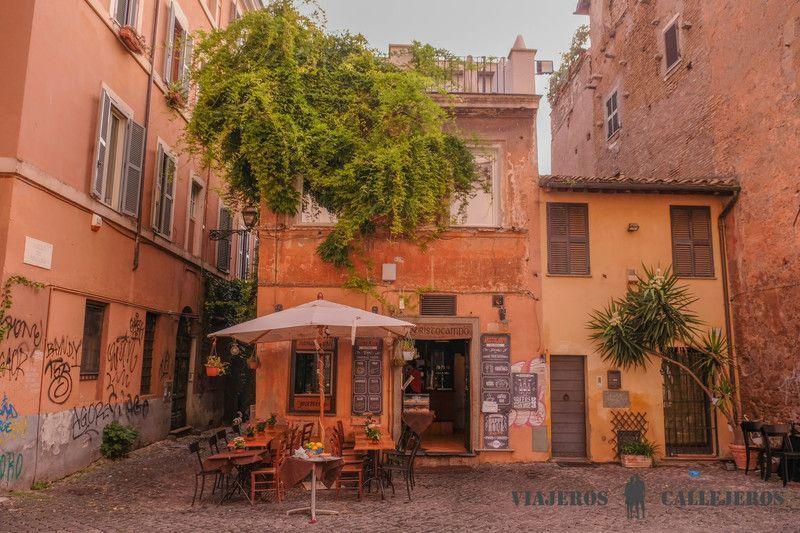 Trastevere
5. Transportation in Rome
The best way to get around the narrow, pedestrianised streets of Rome's historic centre is on foot.
Getting around the area by public transport is more complicated and we only recommend using public transport to get to the furthest points of the city such as the Catacombs or the Vatican.
If you're not much of a walker or have mobility issues, Rome's metro, bus and tram networks make for a good, cheap and convenient public transport network.
The metro has only three lines and is the fastest way to get to places like Villa Borghese, Spanish Steps, the Vatican, the Colosseum and the Trevi Fountain, getting off at the Barberini stop.
To get to other parts of the city and to get around at night, the best option is the bus with over 350 lines and the tramway with six lines.
The price of a ticket on all these means of public transport is 1.50 euros each way, while a day pass costs 6 euros. You can also buy a 3-day tourist pass for 16.50 euros or a one-week pass for 24 euros.
Remember that you can buy the ticket in most tobacconists and kiosks in the city.
In case you have bought the OMNIA Vatican & Rome Card you will have the transport in the city included.
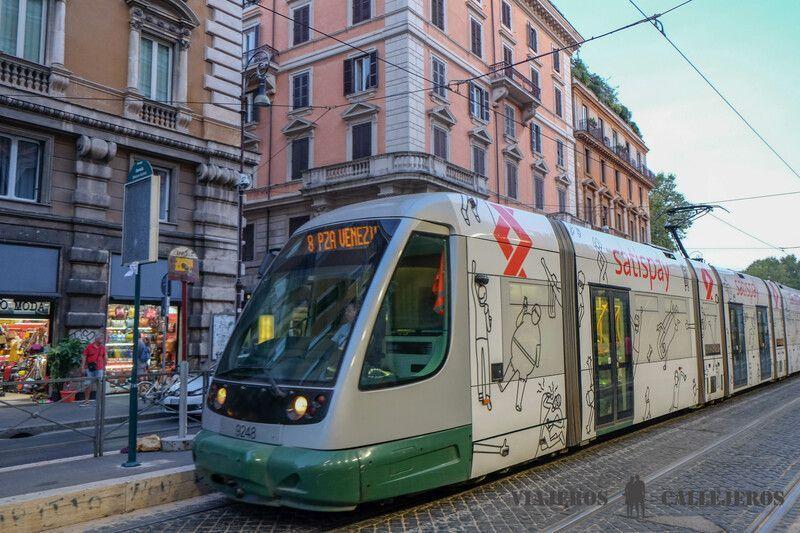 Tramway in Rome
6. Points of interest when travelling to Rome
Another of the best tips for travelling to Rome and not missing anything important is to complete this list of things to do in Rome, enter one of the best Roman catacombs and fall in love with the 10 places to see in Trastevere, our favourite neighbourhood in the city.
Before you start your visit to all these tourist attractions, it is highly advisable to check if it is cost-effective to book the OMNIA Vatican & Rome Card, a card with which you will have free access to the following points of interest:
Vatican Museums
Sistine Chapel
St. Peter's Basilica
St John Lateran Basilica
St. Peter's Prison
Rome Sightseeing Bus (72 hours)
In addition to the above mentioned sites, you will have free access to two of the following tourist sites in Rome:
Colosseum, Roman Forum and Palatine Hill.
Capitoline Museums
Castel Sant Angelo
Borghese Gallery
The card also offers a discount to more than 30 monuments in Rome and above all, it allows quick access to avoid queues at all these attractions.
Please note that at places like the Colosseum, the Vatican Museums and St. Peter's Basilica, queues of more than 3 hours can form.
You can find all the information about Rome's tourist cards in the following posts:
OMNIA Card: how it works, what's included and prices
Roma Pass: how it works, what's included and prices
Which is better, OMNIA or Roma Pass?
7. Routes around the city
Before travelling to Rome or leaving your hotel, it is advisable to take a good look at the walking or public transport routes you are going to take around the city, in order to make the most of your time.
Depending on how many days you have, we recommend between 4 and 6 days if it is your first trip, you will be able to get a good overview and visit the main monuments of this endless city.
Based on our experience of the time we have spent in the city, we have made these routes optimized according to the days you have available:
Guide to Rome in one day
Guide to Rome in two days
Guide to Rome in 3 days
Guide to Rome in 4 days
Guide to Rome in 5 days
In these routes it can be very interesting to include some of these free tours in Rome that will allow you to get to know the great history of the city thanks to the company of an expert guide in English.
It is also very interesting to take the following guided tours that allow you to have a broader view and not have to queue at the most famous places in Rome:
If you don't want to take a guided tour you can book these tickets which will allow you to skip the queues and ensure you a place, which is very important as tickets sell out quickly.
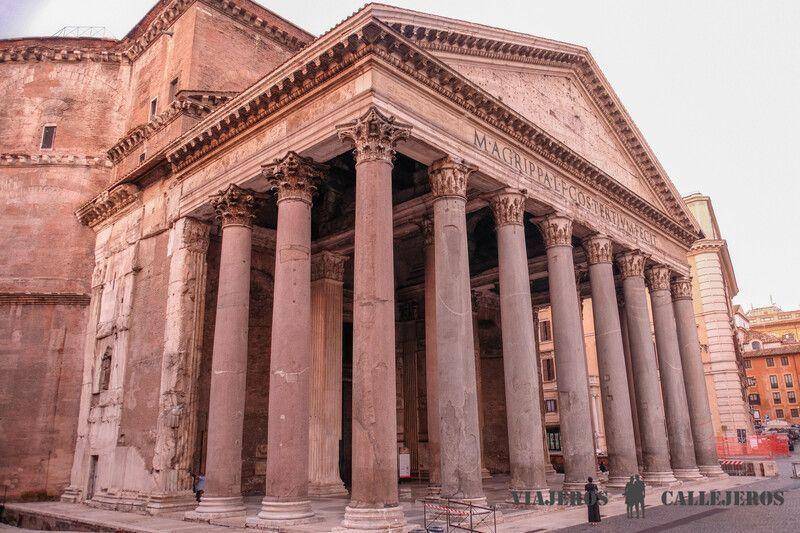 Pantheon of Agrippa
8. Where to eat in Rome?
One of the best reasons to travel to Rome is to try its delicious cuisine, which is among the best in the world.
Some of the most typical dishes of the city are:
Spaghetti alla carbonara: pasta accompanied by a sauce based on eggs, pancetta or guanciale, black pepper and, above all, no cream.
Cacio e pepe: pasta with black pepper and the delicious Pecorino Romano cheese, our favourite next to carbonara!
Penne all'arrabbiata: macaroni with tomato, garlic and hot red pepper.
Saltimbocca: typical Roman dish made with veal, ham and sage.
Carciofi alla giudia: deep fried artichoke.
Supplì alla romana: rice croquettes stuffed with cheese.
Bucatini all'amatriciana: pasta with a traditional sauce made of tomato, bacon, onion, pecorino cheese, pepper and olive oil.
Gnocchi alla romana: disc-shaped pasta cooked in milk and au gratin.
Trippa alla romana: tripe with tomato sauce, fried vegetables and pecorino cheese.
Gnocchi alla romana: disc-shaped pasta cooked with milk and au gratin.
Tiramisu: homemade dessert made with coffee, sponge cake and mascarpone cheese.
After a meal in a restaurant in Rome, it is customary to have a shot of limoncello, a lemon-flavoured liqueur.
All these typical dishes and others, you can eat in our favourite restaurants in the city that we include in this post about places to eat in Rome and in this one about where to eat in Trastevere.
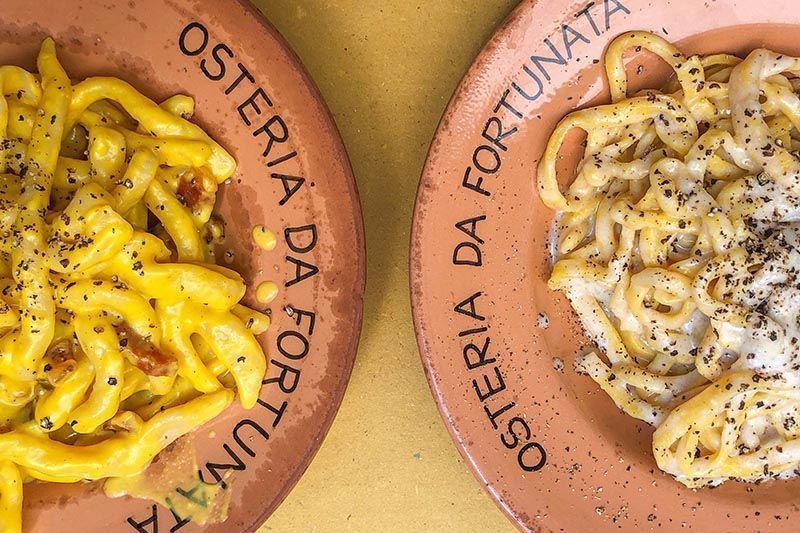 Roman Pasta
9. Tours and excursions
If you are travelling to Rome for more days than usual, this will allow you time to take a day trip to some of the most incredible places to see in Italy such as: Florence, Naples and Pompeii and Villa Adriana and Villa del Este.
The first recommendation would be a day trip to Florence from Rome. This city, located just over an hour away by train, is a real open-air museum full of museums, squares, buildings and monuments made by the great masters of the Renaissance.
You can find more information in this post on how to get from Rome to Florence.
Another great getaway from Rome is the city of Naples and the impressive ruins of Pompeii. After a stroll around this characterful city and sampling some of the best pizza in the world, you can take a train to visit Pompeii, the best-preserved city of the ancient Roman Empire.
You can learn more about the transfer by reading this post on how to get from Rome to Pompeii and this one on how to get from Rome to Naples.
The last suggestion is to visit Villa Adriana and Villa del Este from Rome, two World Heritage Sites, located only 30 kilometres away. Villa Adriana is one of the best preserved complexes of the Roman Empire and Villa del Este is a beautiful palace that impresses with its Italian and Renaissance style gardens.
The most convenient way to get to all these places, if you don't want to rent a car or use public transport, is to book one of the best excursions from Rome with an English-speaking guide.
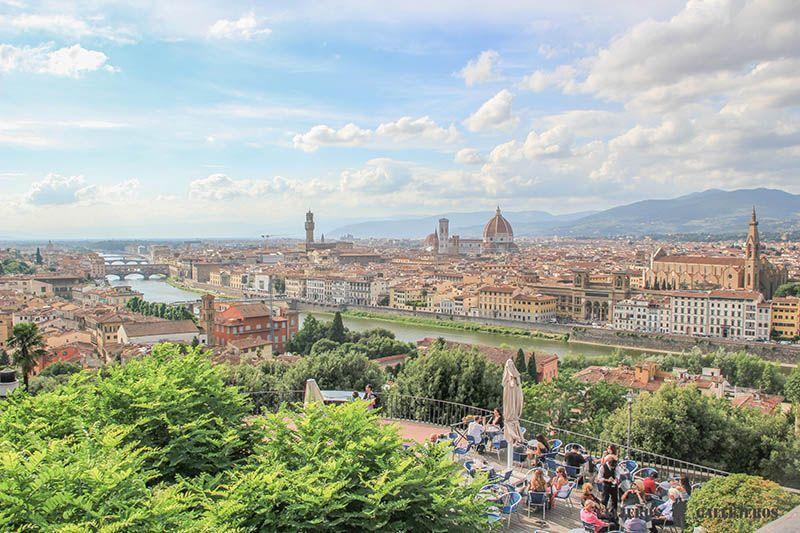 Florence
10. More Rome travel tips
Other top tips for travelling to Rome include:
Check the prices of menus, drinks and "coperto" before sitting in any restaurant located in a tourist area.
Remember that to avoid paying commissions and to always have the current exchange rate, we recommend you use the Revolut card and the N26 card, which are the ones we use, are free and will save you a lot of money.
In Rome, if you use a Spanish mobile phone and have a company like Vodafone, roaming is included, so you can talk and surf at the same rate as in Spain.
Arrive at dawn to famous places like the Colosseum or the Trevi Fountain, if you want to take pictures without people.
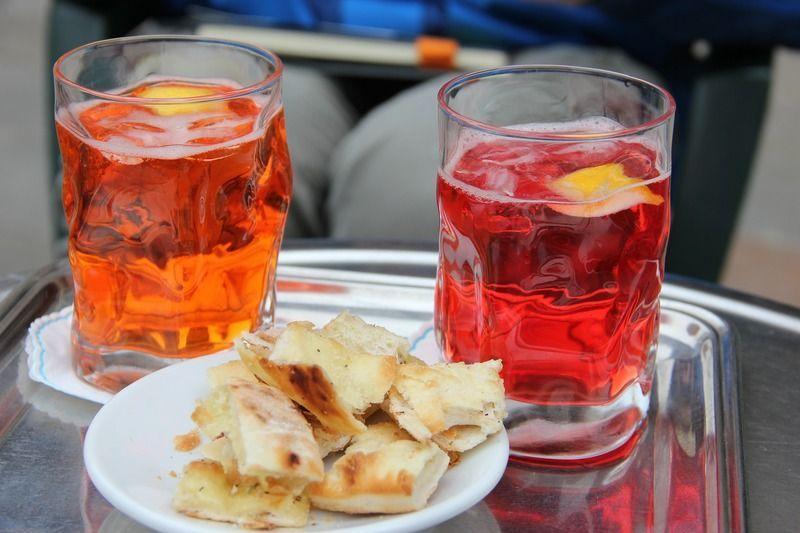
Enjoy the Italian aperitif in the evening, which consists of an alcoholic drink such as Spritz accompanied by a small buffet that the restaurant or bar itself offers free of charge.
The current is 230V/50Hz and the plugs are type F/L, the same as in Spain.
Learn some Italian words such as Buon giorno (formal hello), ciao (hello and informal goodbye), prego (you're welcome), per favore (please), bene (well), grazie (thank you), non lo so (I don't know), scusa (excuse me) and non capisco (I don't understand).
The prefix to call Rome is 9 and to call Italy +39.
If you are planning to visit other parts of the country, we recommend you to read this list of tips for travelling in Italy.